Imagine a pet parent asking an AI assistant whether your dog walking company offers weekend visits. The answer comes back immediately: “Yes, weekend dog walking is available throughout your service area.” The response sounds authoritative, but there’s one problem. Your company stopped offering weekend walks six months ago.
The AI didn’t call your office or check your current booking calendar. It generated an answer using information it could access or had previously learned, and some of that information may have been outdated, incomplete, or simply wrong.
As more pet parents turn to ChatGPT, Gemini, Perplexity, and other AI tools to research local services, these mistakes create a new challenge for pet businesses. AI can sound remarkably certain about information it hasn’t verified.
Understanding AI accuracy and pet business information hallucination is becoming an important part of managing your online reputation. The goal isn’t to stop using AI. It’s to understand its limitations and ensure the information people find about your business is as accurate as possible.
What Is an AI Hallucination?
An AI hallucination happens when an artificial intelligence system generates false, misleading, or unsupported information but presents it as factual.
Unlike a traditional search engine that primarily provides links to existing webpages, generative AI creates responses based on patterns in information it has learned or retrieved. That allows it to answer complex questions conversationally, but it also creates opportunities for mistakes.
An AI assistant might invent a service your business doesn’t offer, provide an outdated price, confuse your company with another local business, or describe qualifications your team doesn’t have.
The problem is that these responses often sound just as polished as accurate ones.
AI systems can express uncertainty, but confident wording doesn’t prove an answer has been verified. Even responses containing citations can misinterpret information or rely on outdated sources.
For pet businesses, that distinction matters because clients may make booking decisions based on information that sounds reliable but isn’t.
How Often Does AI Actually Get Things Wrong?
The client’s research source, AI Business Weekly’s 2026 hallucination statistics, reports an estimated average hallucination rate of 8.2% across major AI models. That’s roughly one in every twelve responses containing fabricated information.
However, that number needs context. Hallucination rates vary considerably by model, question, and how accuracy is measured. A system summarizing a supplied document may perform much better than one answering an obscure factual question without reliable sources. The 8.2% figure is a reported estimate, not a universal error rate for every AI interaction.
For pet care professionals, the exact percentage matters less than the risk of an incorrect answer reaching a potential client. A fabricated detail about your business could influence someone’s decision before they ever visit your website.
The Air Canada Chatbot Case Shows Why Accuracy Matters
A widely reported Canadian tribunal case demonstrates how costly inaccurate AI-generated information can become.
In 2022, an Air Canada customer used the airline’s website chatbot to ask about bereavement fares following a family death. The chatbot incorrectly told him he could purchase a ticket and apply for a bereavement discount afterward. Air Canada’s actual policy required different arrangements.
When the airline refused the requested refund, the customer took the dispute to British Columbia’s Civil Resolution Tribunal.
In 2024, the tribunal found Air Canada responsible for the inaccurate information provided through its website chatbot and ordered the airline to pay damages and related costs. The decision rejected the idea that the chatbot was somehow separate from the company operating it.
The case, covered by The Hill, illustrates an important principle: businesses cannot assume that automated information is harmless simply because a human employee didn’t provide it.
Pet care professionals face an important distinction. Air Canada’s case involved a chatbot operated on its own website. An independent AI assistant such as ChatGPT incorrectly describing a pet business is not automatically the same legal situation.
Still, the reputational lesson applies. If an AI tool tells a pet parent that your business offers holiday boarding, accepts certain breeds, or charges a particular rate, you may be the one dealing with the disappointed client when that information turns out to be wrong.
What Could AI Get Wrong About Your Pet Business?
Some AI mistakes are relatively minor. Others can create genuine problems for your business and the pet parents relying on it.
Consider a pet sitter who recently expanded into a neighboring community. An AI assistant might continue describing the old service area, leaving potential clients unaware that care is now available near them.
The reverse can also happen. AI might recommend your company to someone outside your service area because an outdated directory listing still identifies a city you no longer serve.
Pricing creates another opportunity for confusion. If your website contains an old holiday rate or a third-party listing displays outdated information, an AI-generated answer might repeat that amount as though it were current.
Even qualifications can be misrepresented. An AI assistant might incorrectly describe a business as certified, bonded, or trained in a particular specialty.
These mistakes matter because pet care is built on trust. Clients need accurate information before deciding who will enter their homes, handle their pets, administer medication, or provide care while they’re away.
Why Correct Information on Your Website Is So Important
You cannot directly control everything an independent AI platform says about your business. You can, however, improve the quality and consistency of the information available online.
Start with your own website.
Your service pages should clearly explain what you offer, who you serve, and where your services are available. Keep pricing information current wherever you publish it, and make your booking policies easy to understand.
The same applies to business hours, contact information, professional qualifications, and seasonal availability.
Your Google Business Profile and relevant directory listings should reinforce those details rather than contradict them. If your website says you serve five communities but an old directory lists only two, you’ve created unnecessary uncertainty.
Accurate information doesn’t guarantee that AI will repeat everything correctly. But maintaining a clear, consistent online presence gives search platforms better information to work with and makes it easier for prospective clients to verify what they read.
For more on building that foundation, see Barketing’s guide to getting AI to recommend your pet care business.
Don’t Wait for a Client to Discover the Mistake
One of the simplest ways to understand what AI knows about your pet business is to ask it directly.
Try questions a prospective client might ask: Does your company offer overnight pet sitting? Which cities do you serve? Are you accepting new clients? What qualifications does your team have? What are your holiday rates?
Compare the responses with your current website and business policies. Look for incorrect details, missing services, outdated information, or claims that cannot be verified.
If something is wrong, investigate where that information may be coming from. Check your website, Google Business Profile, directory listings, and older content for contradictions. Correct what you control, then check again over time.
Keep in mind that one AI response is only a snapshot. Different tools, prompts, and search sessions may produce different answers, so repeated checks are more useful than treating a single result as definitive.
Barketing Beacon Helps You Find What AI Has Wrong
Manually checking several AI platforms takes time, especially when you’re also managing bookings, employees, and daily pet care responsibilities.
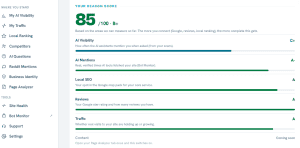
Barketing Solutions developed Barketing Beacon to help pet care professionals understand how AI platforms represent their businesses.
One feature, AI Knowledge Check, lets you ask AI what it currently knows about your company and identify incorrect, outdated, or missing details. Instead of discovering a problem after a client calls about a service you don’t offer, you can spot potential misinformation and work to correct its underlying sources.
Beacon also provides AI visibility tracking and Entity Confidence analysis, helping businesses examine whether their information is consistent across their online presence.
The important distinction is that Beacon helps you find and investigate problems. It cannot guarantee that every independent AI platform will immediately update its answers after you correct a listing or website page.
Your Business Reputation Deserves More Than an AI Guess
AI tools are becoming part of how pet parents research local services, but a confident answer isn’t always accurate.
A fabricated price, outdated service area, or incorrect qualification can create confusion before a potential client ever contacts your business. And while you cannot control every AI-generated response, you can take responsibility for keeping your own information accurate and checking how your company is represented.
The lesson is not to distrust every AI answer. It’s to stop treating confident language as evidence that the information has been verified.
With clear website content, consistent business listings, regular reviews of AI-generated answers, and tools like Barketing Beacon, pet care professionals can identify misinformation earlier and give search platforms more reliable information to work with.
AI confidence isn’t the same as accuracy. Your clients deserve the difference.

Erika Godwin is the President of Barketing Solutions and the Co-Founder and CMO of ProPet Software, an industry-leading kennel management software. Erika has over 8 years of experience with WordPress and graduated from Elmira College in 2009 with a BS, Business Administration- Marketing and Management. View Erika’s Full Bio.